

Rating: NR | Runtime: 100 minutes
Release Date: October 14th, 2022 (Canada) / June 2nd, 2023 (USA)
Studio: MK2 Mile End / Yellow Veil Pictures
Director(s): Charlotte Le Bon
Writer(s): Charlotte Le Bon / Bastien Vivès (graphic novel Une Soeur)
Tell me your biggest fear.
Writer/director Charlotte Le Bon says it best when describing her film Falcon Lake with one word: melancholy. She says we must tame melancholy and make it a “friend for life against sadness.” It’s a beautiful sentiment that does well to pinpoint the prevailing mood during the summer tryst between thirteen-year-old Bastien (Joseph Engel) and sixteen-year-old Chloé (Sara Montpetit) that unfolds.
He doesn’t want to be there at first—dragged along by his parents to spend the summer with Mom’s old friend. She doesn’t want him there, believing he’s a burden to a carefree and independent lifestyle rivaled only by her hippie, free-spirited mother. Chloé sees something of herself in him, though. A battle between the desire to fit in and stand apart. He’s not like the immature sex-crazed teens she’s surrounded by. At least not outwardly so.
Loosely adapted from Bastien Vivès’ graphic novel Une Soeur, Le Bon and collaborator François Choquet gradually reveal a blossoming kinship between the two. Bastien becomes a buffer of sorts for Chloé when out with her older friends in the area, a lifeline away from the burden of expectations. It’s in that role that he flourishes, escaping his shell to impress the group with his dance skills and surprise Chloé with his candor.
She opens up to him. She finds a position of control and power to progress at her own pace with Bastien’s excitable yet innocently fearful permission. Is it a romance? Maybe. Is it a dream-like summer of possibility devoid of strings? Perhaps. Neither has an answer nor a need to find one. They give each other their full trust to simply live while jealousy and heartbreak and anticipation come along for the ride.
If you’re anything like me, you’ll soon be scratching your head as to the description of the film being a “love and ghost story” since the latter seems but a red herring of distraction. A ghost story exists on the screen, but it’s one that Chloé shares about a boy drowning in the lake by their cabin. She’s fascinated by the macabre—a fact that quickly puts distance between her and those her age who find it difficult to stop taking themselves too seriously.
Her mother says she wants attention. A neighbor teen calls her childish. Bastien just smiles and helps foster the ghoulish fantasy in staged photographs and masochistic games of biting their hands until drawing blood. But we know it’s a lie. We know it’s a mechanism Chloé uses as a litmus test to judge those who want to be close to her. So, don’t get lost in any expectation of horror. This “ghost” isn’t necessarily literal.
You could say the real ghost is love itself. That invigorating sense of inclusion and fullness that can so easily and unexpectedly disappear, haunting those who’ve lost it. Bastien’s parents are the exception: lasting love. Then there’s Chloé’s mom finding herself dating the men she helps buy cabins on the lakeshore and Chloé herself dealing with boys more interested in conquest than romance.
Bastien is supposed to be different. His youthful ignorance is supposed to save him from the patterns in which those older than him find themselves lost and/or facilitating. As the film delicately and authentically progresses Bastien and Chloé’s friendship, a new question arises: Is it enough to just be loved or must you ensure the world knows it too? Can he be the person she needs him to be? The person he probably truly is? Or does peer pressure and his own desire to not be alone push him to risk everything for cred?
The result shows how wide the gap is between them. Bastien has only just become a teen and so he’s still finding his place in an ever-expanding world of expectations. Chloé is already there. She knows what she wants and what she doesn’t. She knows how others will try to force her to compromise that decision and the internal fight against the pressure to do so. That’s why her biggest fear is so much deeper than his: to not be alone.
Bastien hasn’t yet been hurt or done the hurting to think of a fear worse than mere embarrassment. The tension therefore lies in finding what it is they will do to avoid the loneliness when it inevitably consumes them both and whether each other can be enough. How far will they compromise? How great is the danger they’ll confront to avoid it? Fear often drives us towards actions that end in regret until we become the ones bringing our own ghost stories to life.
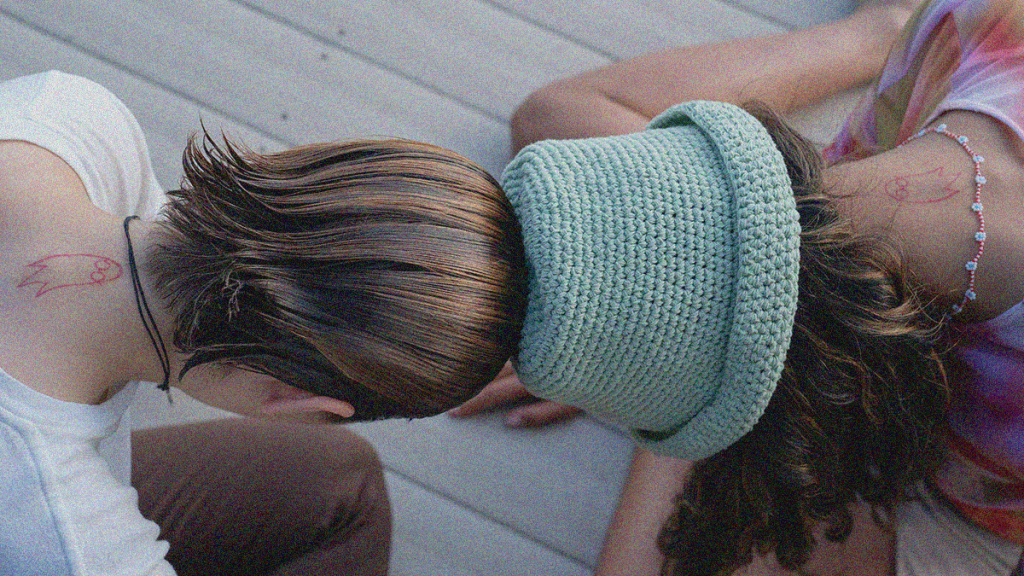
Joseph Engel and Sara Montpetit in FALCON LAKE; courtesy of Yellow Veil Pictures.
 jaredmobarak.com
Leave a comment