
Rating: TV-MA | Episodes: 8 | Runtime: 30 minutes
Release Date: May 4th, 2023 (USA)
Studio: Peacock
Creator(s): Pete Davidson, Judah Miller & Dave Sirus
You run away from people who love you.
I’m glad I decided to finally catch-up to The King of Staten Island before watching Pete Davidson’s “Bupkis” because it really messed with my expectations. The Judd Apatow film is a semi-autobiographical account of the comedian’s life, but it takes a heartfelt look at grief and arrested development while fictionalizing where its alt-reality Davidson’s life could have gone. I don’t therefore think it was wrong to assume his latest reimagining of himself would be the same. Perhaps that’s even the hope since what he delivers is very different.
There’s still a bit of heart in every episode of this first season, but the major takeaway is the unhinged combination of absurd comedy and gonzo cameos. Davidson is conducting a roast on himself and the industry. He’s roasting his family, identity, and celebrity with zero restraint, taking us through the disturbing rabbit hole of how nonsensical it is to always have your private life be so publicly judged.
The persona on-screen is present-day Pete Davidson. Everyone knows who he is. He goes everywhere with his entourage. And Hollywood is locking him into that exploitative position of wanting to sell their product with his name but not wanting to deal with the inevitably unwholesome image the media will be presenting during his tenure of employment.
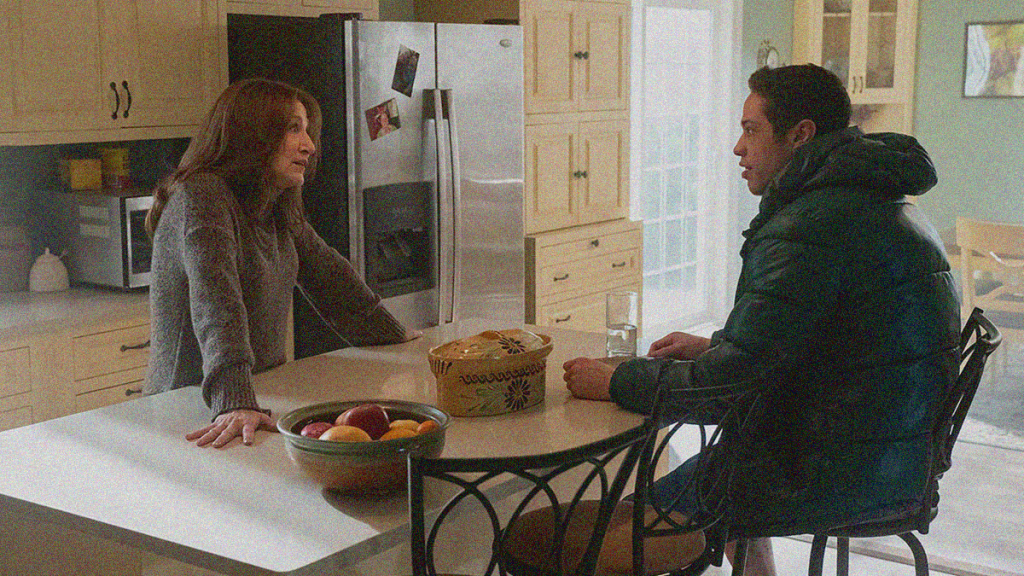
He’s living on Staten Island with his mother Amy (Edie Falco)—or, as he likes to describe it, she’s living with him since he pays the mortgage. Hitting comedy clubs and traveling the country doing gigs that will hopefully advance his acting career. Sometimes he’s being forced by his agent (Chris O’Donnell) to play nice and perform a kid’s birthday party to get in with an A-lister. Sometimes he’s trying to get away from it all by hanging with his grandfather (Joe Pesci’s Joe) to acquire some sage, profanity-laced wisdom.
The format is skit-like in construction. There are constant callbacks to previous events and consistent character arcs, but each episode possesses its own unique setting and/or purpose. A nostalgia-fueled trip down memory lane with flashbacks to Pete’s aunt’s wedding (to Bobby Cannavale). A high-octane adventure in Florida to earn an audition with the Fast and Furious gang that turns into a madcap parody of the franchise courtesy of a cartoonishly “crispy” Simon Rex.
There’s an amusement park, Canadian film set, and even a rehab clinic, each with its insane share of unforgettable faces playing kooky side players (Method Man is my favorite) or extreme caricatures of themselves (Sebastian Stan and Ray Romano are a lot of fun). Add a bunch of people from The King of Staten Island, a recurring Brad Garrett as Joe’s best friend, and even Art the Clown to discover you really can’t anticipate just how off-the-wall things might get.
In the end, though, it’s also about growth. Not as much as the Apatow film, but enough. Outside that goal, Davidson and co-writers Judah Miller and Dave Sirus are giving themselves a lot more leeway to leave audiences laughing by any means necessary. Nothing is out-of-bounds. Semen. Prostitutes. Bazookas. Dave Attell. Whatever random thing they can inject into the script to liven things up regardless of whether its success is because of how well it fits the story or how out-of-place it proves.
That means Falco and Pesci are allowed to go crazy at times too. Yes, they’re the “voices of reason” in this circus, but they’re also the two who helped raise Pete to be who he is today. Because they’re fallible and prone to going overboard too, he can be himself without worrying about the consequences. The real saints are his sister (Oona Roche) and on/off girlfriend (Chase Sui Wonders). They’re the ones who are difficult to listen to because he’s both a screw-up who can’t and truly desperate to never disappoint them.
“Bupkis” is a tight eight episodes with an extremely shameless Davidson leading the way. The family stuff works well because of Falco and Pesci’s help, but I’ll admit I was much more invested in the “inside baseball” stuff like the psychological effect of constantly seeing people talk bad about you on the internet, the chaos of loved ones hearing unsubstantiated reports that you died, and a frank conversation between friends (John Mulaney) about drug abuse and personal demons that can maintain seriousness despite its wink of artifice.
And since it’s a television show with less financial risk than a Hollywood theatrical feature, it doesn’t need a happy ending. It can just exist as the messy exploits of a well-meaning but chronically helpless man-child who simply doesn’t have the attention span to steer the ship on-course. Davidson is giving us what we already believe and embellishing it so far beyond plausibility that we must question whether any of it was ever really true.

Edie Falco and Pete Davidson in BUPKIS; courtesy of Peacock.


 jaredmobarak.com
Leave a comment