
Rating: NR | Runtime: 101 minutes
Release Date: February 17th, 2022 (Ukraine) / November 25th, 2022 (USA)
Studio: XYZ Films
Director(s): Oleh Sentsov
Writer(s): Oleh Sentsov
Are you immortal?
Oleh Sentsov’s Rhino is worth a watch for its opening twelve-minute faux one-take montage of Vova’s, aka Rhino, (Serhii Filimonov) childhood in 1980s Ukraine. What starts with him as a little boy huffing and puffing his way through the neighborhood only to poke a kid’s eye out with a stick when a group of bullies jumps him moves smoothly through the mounting tragedies and hardships he and his family faced.
There’s Dad’s prison stints and attempted murder of Mom, his sister’s pregnancy and failed relationships, and his brother’s military service and death in the streets as a gangster upon his return. And all the while Vova is in the background, scrawny but feisty and absorbing every single hit until adulthood arrives to make him just as vicious as the rest.
It’s his temper that starts Rhino’s own descent towards oblivion. He finds himself punching out his own guys or running headfirst into a brawl he can’t win anytime he drinks too much. So, it’s for survival that he contacts Tucha (Georgiy Povolotskiy) to join his crew with best friend Plus (Yevhen Grygoriev). It protects him from an enemy’s recourse (Vladyslav Derduga’s Skull) while also providing the means to give Maryna (Alina Zievakova) and their daughter a nice life.
As the violence and money increases, however, so too does the need for power and control. Soon his own family is met with worse horrors than the ones we witnessed during his adolescence. And this time he has no one to blame but himself—something he admits when telling his story to an unnamed man (Evhen Chernykov) sitting beside him in his car.
This isn’t your usual gangster film, at least not below the surface. Rhino does the types of things you expect (murder, adultery, etc.) while facing the consequences head-on, often growing meaner and more reckless the greater the hits taken. But the movie sets itself apart in Sentsov’s ability to neither glorify nor vilify his lead character. Rhino isn’t a good person, but he does earn our sympathy both because of the life he was born into and the crippling guilt he carries as a result of the actions he commits of his own volition as a product of that life.
The whole is more or less a flashback being told with hindsight and necessary perspective despite never being watered-down or altered to shine its narrator in a better light. Rhino isn’t interested in that. The ghosts of Maryna and others haunt him too often to pretend he isn’t the monster society believes.
What we’re watching is thus a life that cannot be forgotten by the victims, survivors, or Rhino himself. It’s a journey filled with blood and bodies that he must learn to accept. And we feel its burden both in his face (Filimonov is as emotionally expressive as he is fiercely dangerous) and his movements (something as small as his refusal to step foot in a church knowing his soul is all but gone).
It’s a graphic drama that supplies a continual string of death and destruction, but none of it occurs without its impact being felt in full. That also means none of it is left unpunished either. These characters know what they’re doing. They’ve accepted their fate. To repent won’t therefore get Rhino into Heaven, but it might just stifle the guilt-driven psychological unrest for a moment of silence before he inevitably awakens in Hell.
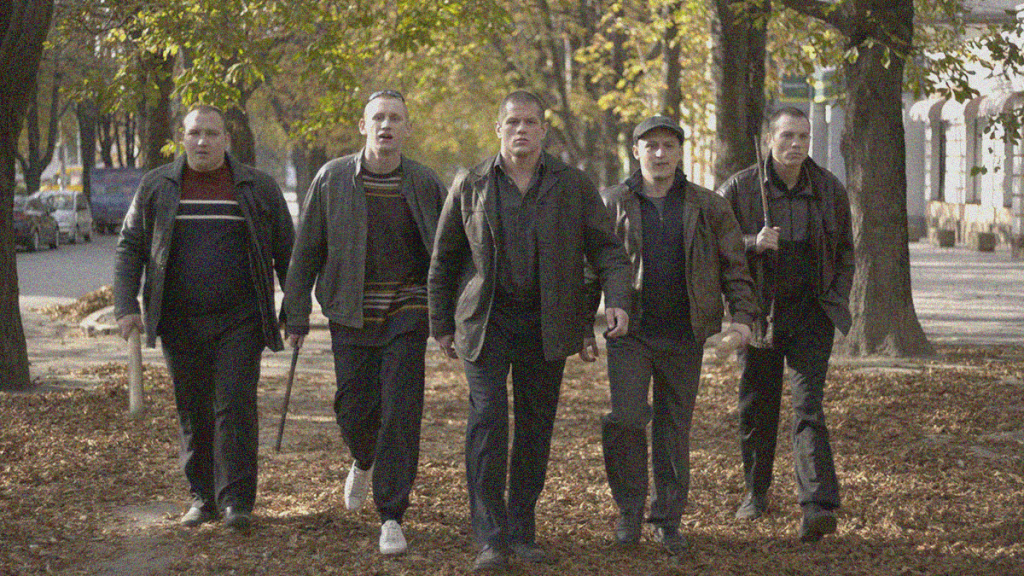
Serhii Filimonov and his gang in RHINO; courtesy of XYZ Films.


 jaredmobarak.com
Leave a comment