
Rating: NR | Runtime: 116 minutes
Release Date: February 23rd, 2023 (Germany)
Studio: Warner Bros. Pictures Germany
Director(s): Sonja Heiss
Writer(s): Sonja Heiss & Lars Hubrich / Joachim Meyerhoff (book)
A normal party with real people would be fun too.
You may think your upbringing was crazy, but how much wilder would it have been if you were raised in a psychiatric clinic? That’s what Joachim Meyerhoff had to deal with—a subject of which he wrote about in his autobiography When Will It Be Again Like It Never Was Before. Director Sonja Heiss (who co-adapted with Lars Hubrich) received a copy as a gift and found it unlike most German novels she’d ever read, laughing out loud at multiple points while also being profoundly moved by its insight. She captures a lot of that duality with her cinematic iteration, letting the eccentrically “free-spirited” life this family lives (for better and, unfortunately, worse) speak for itself as a series of memorably anecdotal gags tied together by Josse’s (Camille Moltzen at 7, Arsseni Bultmann at 14, and Merlin Rose at 25) unique perspective as its circus’ youngest member.
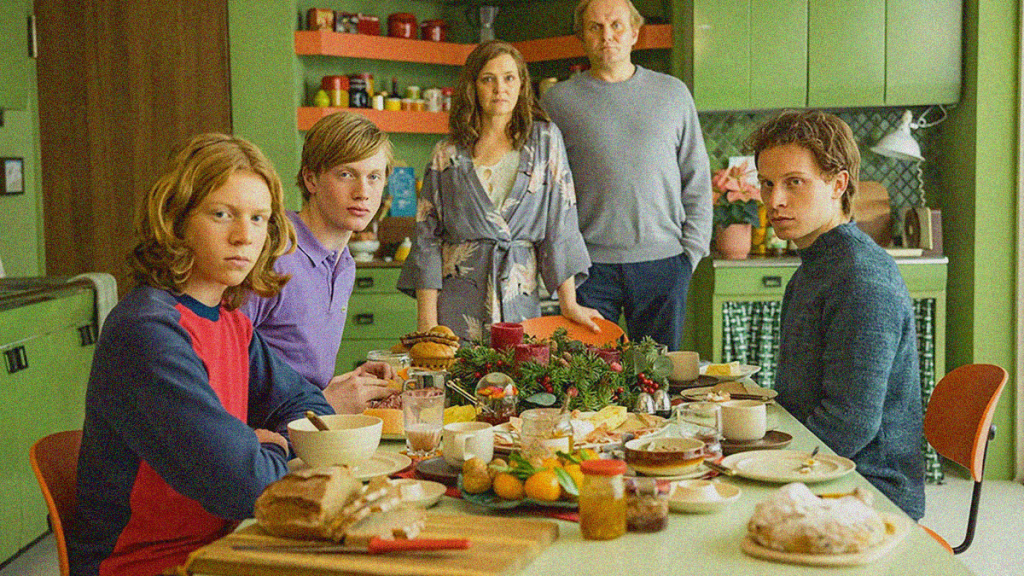
Richard Meyerhoff (Devid Striesow) is the hospital’s director and thus lives onsite with his wife (Laura Tonke’s Iris) and three sons (Josse, Philip and Patrick). They each know the patients well as no one is really confined to any one area of the campus. A young boy roams around with his toy gun. The so-called “Bell Ringer” shuffles around in silence, the sound of his instruments always ensuring you know when he’s near—a prospect that simultaneously instills fear in young Josse and comfort once becoming friends. The patients are ostensibly part of the family with some celebrating occasions in their home like guests to a cocktail party. That belief in fostering a sense of normality comforts Richard. Despite Iris playing along with a smile, however, we know she yearns for more. For an escape that will prove longer and farther away than an afternoon at the beach.
And thus the seeds of discontent are set. Richard and Iris love their boys (even having to deal with Josse’s anger issues that necessitate sitting him on top of a running washer to calm him down), but their own relationship frays. She rightfully feels like a forgotten accessory, her only real pleasure coming from long conversations on the phone with an old flame in Italy. He lives his life on the basis that failure can be avoided—to the point of pretending his obvious and public failures never happened. We can therefore gauge the temperature of this home simply by looking at their bedroom. Are the two beds pushed together to allow for closeness and Josse as a nightly guest? Have they been pushed apart ever so slightly? Or are they on complete opposite ends of the room?
Experiencing that shift from Josse’s eyes renders the narrative into a coming-of-age tale spanning decades of his admittedly weird adolescence. He’s witnessing the dissolution of his parent’s love (culminating in a Christmas for the ages that turns from darkly humorous to heartbreakingly tragic with a scream) while acknowledging his own romantic inclinations with the pretty girls who arrive as patients—a development his brothers have a lot of fun with considering they’ve always considered him the black sheep dullard of the group who has more in common with the residents than them. Even that desire for companionship finds itself mired under a dark cloud of anguish, though. How could it not when faced with the unfortunate circumstances that surround mental illness, narcissism, and death?
Heiss handles these tonal shifts very well with an excellent cast of young actors (Bultmann and Casper von Bülow as teen Philip are standouts) bolstered by commanding, emotionally complex turns from Striesow and especially Tonke. The result may not be for everyone as a majority of the opening portion feels more like skits cobbled together (moments like Josse discovering a body on the way to school having a punchline rather than a lesson) than a cohesive throughline, but the teen years really make up for any of that one-dimensionality. And the closing chapter (adulthood only gets about fifteen minutes at the end) nicely brings everything together with hindsight to remember that we often can’t recognize our own part in our unhappiness in-the-moment. We can only hope clarity and forgiveness comes before it’s too late.

The cast of WHEN WILL IT BE AGAIN LIKE IT NEVER WAS BEFORE.



 jaredmobarak.com
Leave a comment