
Rating: R | Runtime: 92 minutes
Release Date: March 9th, 1984 (USA)
Studio: New World Pictures
Director(s): Fritz Kiersch
Writer(s): George Goldsmith / Stephen King (short story)
Any religion without love and compassion is false! It’s a lie!
The reason Stephen King’s short story Children of the Corn is effective is precisely because it leaves its mysteries to the reader’s imagination. It also rejects mainstream horror’s need to provide a happy ending. So, what does Hollywood do upon adapting it to the big screen? The complete opposite.
They give form to the implicit. They remove internal conflict from Burt (Peter Horton) and Vicki (Linda Hamilton), transforming their antagonistic entry points to an unexplainable world (the real lead of the story) into heroic outsiders come to unwittingly save a town of lost souls from themselves. The result hardly bears resemblance to King’s original work beyond its superficial shell of a setting. It’s merely screenwriter George Goldsmith and director Fritz Kiersch’s sanitized and inert fanfiction.
One of my favorite parts of the source material is the discovery of how long Gatlin, Nebraska has laid in disuse. The gas prices and diner menu. Burt and Vicki are so flabbergasted by the twelve-year time warp they’ve stepped into that they actually stop arguing for a second to contemplate what it means. That’s all gone in the film. Not only has the distance been truncated to three years, but the first thing we see is why that gap was created at all.
The least Kiersch and company could have done was draw out the uncertainty and throw in a flashback later on. Starting with a prologue undercuts the religious commentary completely by putting a face to the carnage before we even meet the “outlanders” stumbling onto its secrets. It gives us a villain and makes us wonder if talk of “He who walks behind the rows” is nothing but a scare tactic.
Burt and Vicki have zero animosity beyond weak dialogue about commitment. They stumble upon the body of a boy in a mostly similar way, but the lack of hate with each other turns a tense situation born from a fear of religion’s power to harm into a rudimentary search for a phone.
Burt says he’s in a hurry, but we never feel it as the film drags everything out—even introducing a narrator in young Job (Robby Kiger) and a “seer of the future” in his younger sister Sarah (Anne Marie McEvoy). And by constantly cutting to cult leader Isaac (a sufficiently creep John Franklin) and enforcer Malachai (Courtney Gains), the whole devolves into a conventional good vs. evil plot wherein the truly intriguing aspects of King’s vision arrive as throwaway context to an explosive finale rather than being the nihilistic point.
How this adaptation spawned double-digit sequels is wild since it truly holds nothing of unique merit beyond a cast of killer children. And even that loses its impact since we’re forced to meet them as brainwashed youths who can be untrained from years of indoctrination by one speech from Burt, a two-dimensional man of science (since King’s Vicki, a reformed evangelical, wasn’t worth expanding upon when a doctor could render emotional trauma moot).
It truly seems like the filmmakers made every single wrong choice possible in their transfer of mediums. They dumbed down the structure and atmosphere, erased all complexity and nuance, and delivered the most by-the-numbers thriller you could conceive from an unconventional text dealing purely in mood and evil.
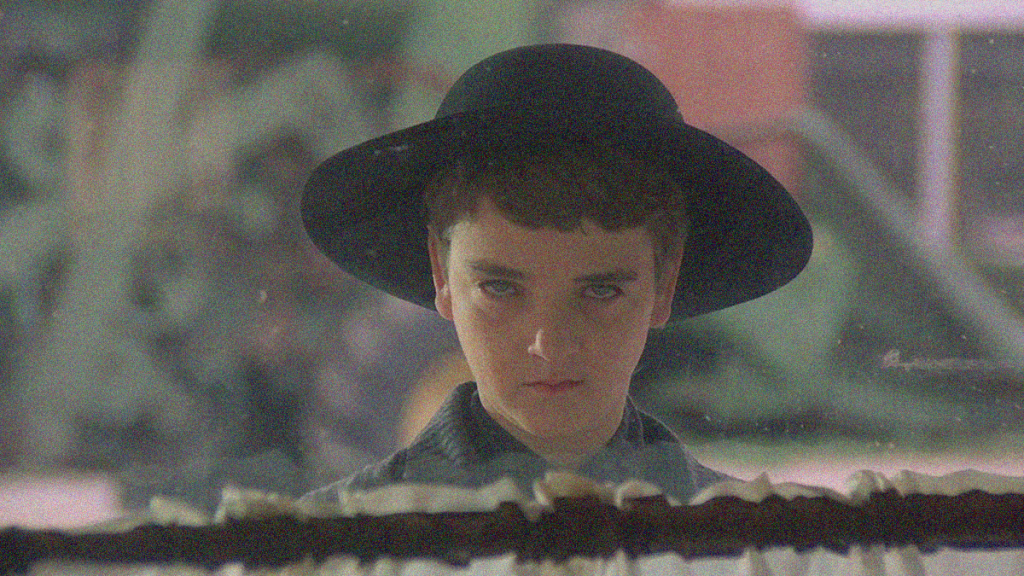
John Franklin in CHILDREN OF THE CORN.




 jaredmobarak.com
Leave a comment