
Rating: NR | Runtime: 91 minutes
Release Date: September 1st, 2022 (Israel) / February 10th, 2023 (USA)
Studio: Kino Lorber
Director(s): Orit Fouks Rotem
Writer(s): Orit Fouks Rotem
I learned very well that nobody can save you but yourself.
Art therapy can be a powerful tool used to dig within your own subconscious and perhaps confront personal truths about yourself and your life that you’ve repressed—either as a means to cope privately or to shield yourself from scrutiny publicly. This can be especially true when the art in question is utilized by those who’ve never attempted to use it in any form.
Suddenly their minds are opened to the possibilities of fictionalization, metaphor, and abstraction. They find themselves in a space all their own to voice their emotions and feelings without the threat of retribution, argument, or abuse. But that vulnerability can also prove dangerous if the setting isn’t fully equipped to handle the consequences.
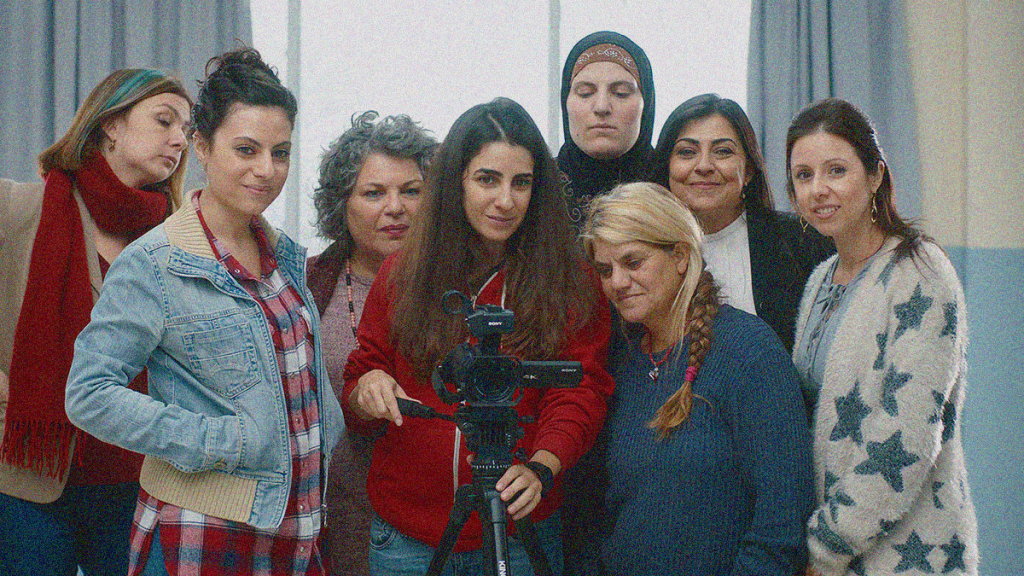
Cinema Sabaya’s writer/director Orit Fouks Rotem creates from experience having been in Rona’s (Dana Ivgy) shoes as a filmmaker teaching a course on filmmaking with a mixed group of Jewish and Arab women in Israel for research. The point is enrichment both artistically and psychologically—to put students into a position where they can share their innermost passions and dreams via exercises that can help provide the confidence to achieve the same in reality.
The reason things grow complicated on-screen isn’t therefore because of act of performing itself, but the disparity between its intent and potential. Because it’s one thing to embolden each other by revealing the struggles they face are universally fought. It’s another to exploit (wittingly or not) each other’s trust to push them past their comfort threshold from productivity to harm.
It’s a slippery slope. Rona is only supposed to show these women how to use a camera, but she’s never taught before. So, it’s no surprise that she ultimately finds herself unable to escape the headspace of a filmmaker upon witnessing the wealth of human drama and introspection that arises when people from different cultures, religions, economic backgrounds, and indoctrination collide.
Whether it’s Eti (Orit Samuel) admitting her knee-jerk fear of Arabs to the point of saying she’s never spoken with one until now or Souad’s (Joanna Said) obvious discomfort whenever the subject of violence or oppression arrives and cuts very close to home, Rona is capturing important insight and catharsis simply by letting her students run with the freedom filmmaking supplies.
You could argue the film does better at presenting conflict than confronting it, but I don’t think that’s a failure to provide answers as much as it is a result of the purpose being to incite rather than solve. In a perfect world Nasrin (Amal Murkus) would connect those who need help with the right contact. Gila’s (Ruth Landau) past would help give Souad the strength to follow in her footsteps. Carmela’s (Liora Levi) untethered independence might inspire Nahed (Aseel Farhat) to pursue her desires.
But this isn’t a perfect world. These women don’t fully understand the context of each other’s pain. And Rona’s wish to capture drama and epiphany has just as much chance of provoking implosion. The purpose isn’t therefore to magically solve centuries of persecution. It’s to remind us that no one is perfect. No one is unequivocally correct. And no one is truly alone.
The cast of CINEMA SABAYA; courtesy of Kino Lorber.


 jaredmobarak.com
Leave a comment