
Rating: NR | Runtime: 76 minutes
Release Date: February 24th, 2023 (USA)
Studio: Buffalo 8 Productions
Director(s): Rubén Sainz
Writer(s): Rubén Sainz
You can’t stay here.
Passed out on the sandy shore of Santa Catarina, Brazil, Beto (Diego Álvarez) finally gets to his feet and stumbles home. What follows is a mostly wordless look into his day-to-day of fishing, selling to local bars in town, and gambling with dominoes at a table run by a man to whom he already owes money.
Things appear to rinse and repeat until a stranger is seen in the distance. We’ll never know the specific details as to why Beto suddenly grows afraid, but we can guess from his violent temper at the sound of this man calling him by a different name. It therefore seems Beto is in hiding and living this simple, drunken life to forget the past he’s left behind. Unfortunately, that past isn’t yet done with him.
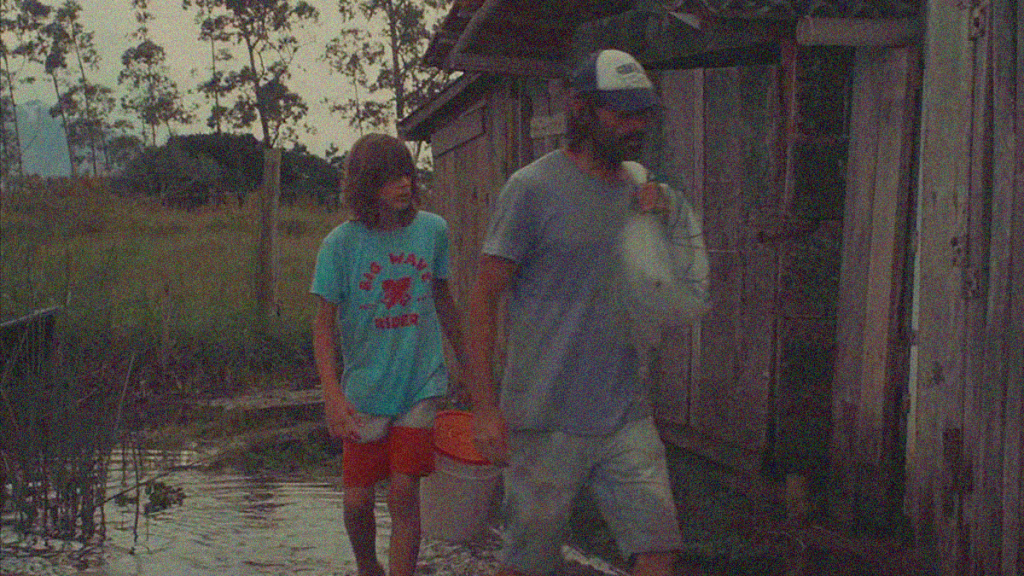
Rubén Sainz’s Magoado soon reveals Beto’s estranged son Markel (Aram Rockenbach), recently arrived from Spain, with the teen getting some of that rage after calling him by that other name too. Not only does Beto demand they speak Portuguese and that the boy call him Alberto, but he also says he’s to now go by Marcelo.
Where then does the danger reside? There or here? Would one person uttering his real name truly spell his demise? It’s not a spoiler to say we’ll never find out because Beto’s past isn’t really important here. This is a very sparse narrative about this estranged relationship between father and son and the former’s fear of living for someone other than himself—not a fear of dying.
How we get to that truth is pretty disjointed. For example: there’s no evidence that Beto has a girlfriend. If not for another woman randomly inquiring about her, we’d never assume to ask the question ourselves since we’re specifically told he’s alone. But there she is to give him a kick in the pants when he needs one the most—the plot always pulling someone out of the woodwork when it needs them before once more forgetting they exist.
It often feels as though we’re intentionally being left in the dark, but not as a means of shielding information. It’s more that Sainz doesn’t want to waste our time with context. He seeks efficiency, sometimes streamlining things to the point of confusion if not an overall indifference.
Thankfully, regardless of my mind drifting throughout, the cinematography always brought me back. Shot with a vertical aspect ratio, Sainz captures some unforgettable images—the beach scenes are particularly gorgeous with a sand-surfing sequence proving a lot of fun too. Because the film must be taking place in this veritable paradise for a metaphorical reason, we assume the claustrophobic nature of the central dynamic will eventually find an equal release.
There will obviously be bumps along the way (Beto is barely trying to be a father), but sometimes people need to be reminded of what they’ve lost before realizing what they want. I only hope the ending’s callback to the start isn’t doing what I think it is. Because introducing the possibility of “fantasy” renders the whole an anti-drinking ad rather than a drama about humanity’s drive to be better that made Magoado’s slow burn worthwhile.
Aram Rockenbach and Diego Álvarez in MOGOADO; courtesy of Buffalo 8.



 jaredmobarak.com
Leave a comment