
Rating: R | Runtime: 130 minutes
Release Date: October 14th, 2022 (UK) / February 17th, 2023 (USA)
Studio: Bleecker Street Media
Director(s): Frances O’Connor
Writer(s): Frances O’Connor
Why is it so hard for you to believe that your sister could write something of merit?
Rather than make a biopic, writer/director Frances O’Connor has created a fiction—one merging aspects of her subject’s life with the novel many consider one of the greatest ever written. It’s a trend that seems to be happening more and more lately with artists looking to honor the spirit and legacy of a person instead of historical fact. And why not?
Documentaries and biographies exist to provide objectivity. Emily exists for those who want more. Fans who cherish the words Emily Brontë put to page and yearn to experience a version of events that mirrors the world she created. Because maybe that’s how she saw her own. Think the likely apocryphal stories about Van Gogh being influenced by mercury and/or lead poisoning to the point where his paintings weren’t expressionistic. They were reality.
I’ve never read (nor seen an adaptation of) Wuthering Heights, so I will have to go by what I’m told as far as a mysterious sense of the supernatural lingering in the background of its pages. I remember it in Cary Joji Fukunaga’s Jane Eyre (written by Emily’s sister Charlotte), though. And an early scene here where Emily (Emma Mackey) plays a guessing game with her siblings and their parrish’s new curate (Oliver Jackson-Cohen’s William Weightman) embodies it too.
Have the Brontës been visited by a ghost? Or has Emily’s thrillingly electric imagination grabbed hold of the moment to stir something pure within her companions? It’s enough to confirm talk of her being the “strange one.” And for Weightman to wonder if something ungodly resides within.
That uncertainty colors so much of what O’Connor has created from the inevitable romance that sparks between Emily and Weightman to the volatile dynamic shared between siblings that can’t help mixing their immovable love with an undeniable jealousy (both with Fionn Whitehead’s brother Branwell and Alexandra Dowling’s sister Charlotte).
They all want Emily to write even as her shy insecurities (courtesy of some of those same people telling her to grow up) push her to stop. Her father wants her to be a teacher, like Charlotte. Weightman wants her to find God. And as everything she cherishes begins to crumble before her eyes, she can’t help but wonder if they’re right. Maybe the time for storytelling has passed. One glimpse at her poems, however, can make even her most pragmatic detractors believers of her unparalleled talent.
Emily is a gorgeous film—emotive, thrilling, and also quite charming whenever it pairs Emily up with another to wryly smile while others scowl at them. Mackey performs the role with an infectious energy that runs through the highs (drug use, sex, trespassing) and the lows (heartbreak, failure, and death).
This is a young woman struggling to stand in the way of a societal and cultural tidal wave demanding conformity when the unique brilliance their pressure subdues via panic attacks is the exact thing that will ultimately have them applauding her as a genius. That she must endure so much pain and lose so much love to finally listen to her gift is a tragedy. But it pushes her forward. It inspires her voice. And, in this fictionalized iteration, ignites that same fire in sisters already thought lost.
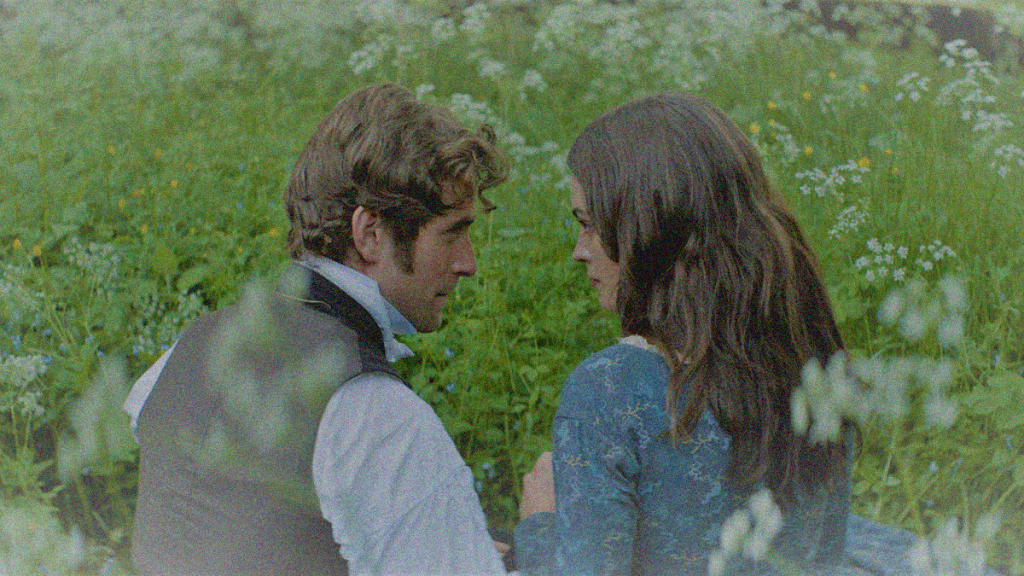
Oliver Jackson-Cohen (left) and Emma Mackey (right) in EMILY; courtesy of Bleecker Street.




 jaredmobarak.com
Leave a comment