
Rating: NR | Runtime: 122 minutes
Release Date: February 17th, 2023 (USA)
Studio: Samuel Goldwyn Films
Director(s): Eromose
Writer(s): Eromose
I don’t think they were expecting to run into Black Rain Man.
There are a lot of familiar faces in Eromose’s 88, one of which belongs to Kenneth Choi. He only has one scene (and no name), but the dialogue shared between him and Brandon Victor Dixon’s Femi Jackson (the film’s lead) epitomizes exactly what this term-paper-turned-political-conspiracy-thriller delivers.
Their conversation is meant to make audiences wriggle in their seats as hot button racial issues are thrown about in jest with a Black and Asian man comparing legacies of suffering with present-day danger. Rather than simply riffing, however, their banter becomes bogged down by an overwritten proselytizing. We are meant to learn something so profound that natural rhythm takes a backseat to verbosity. It’s exhausting.
It’s also constant. A conversation between friends? No. A lecture. An emergency office meeting? Lecture. If two people are on-screen, you can be sure they’re speaking to us rather than each other. So, why not make a documentary? There are multiple instances where Eromose brings in archival materials as evidence to lend credence to his dialogue. And anyone living in America as a self-described liberal knows the conspiracy at the back of this film is logically realistic if not unfolding as we speak.
So, why mask it in fiction and risk turning its legitimate talking points into fodder for mockery? If I were to hazard a guess: Dinesh D’Souza. If Eromose presented this look at the white supremacist stranglehold on America as instructional (while still going this hard tonally), it would be dismissed as easily as D’Souza’s right wing propaganda.
That’s not to say 88 won’t anyway despite it calling out the system itself regardless of party affiliation. By centering on a Black family with obvious cause to question the world around them (cue more heavy-handed sermonizing, albeit with some visual and emotional panache when dealing with topics like teaching young Black children how to interact with police and becoming part of the inherent bias against one’s own oppressed people) fighting against literal Nazis, however, you can’t avoid political bias.
That’s where Orlando Jones’ Harold Roundtree enters. He’s a Black democrat running for President for whom Femi—the financial manager of his campaign’s largest super PAC donor—discovered an unbelievable hidden truth. Roundtree’s campaign, and maybe his entire life, has been secretly bankrolled by the “Crooked Cross” (a KKK equivalent, not the Slayer song).
Now we need a rudimentary education on super PACs, non-profits, and Citizens United to wrap our heads around what that means and how it could happen. Instead of following The Big Short’s example with fourth wall-breaking asides, we learn via more heavily overwritten dialogue courtesy of a recurring interview between Roundtree and William Fichtner’s Ron Holt and the on-the-ground fact-finding mission spearheaded by Femi and his financial blogger pal Ira (Thomas Sadoski).
Less fun, more constrained, and always pivoting towards a new adventure in clandestine operations with nothing but a presidential candidate’s social security number and a can-do attitude. Add a baby on the way, uncertain allegiances with morality, and the underlying message that all politicians are crooked and all power corrupts (you don’t say?) and you quickly realize the endeavor is mostly hollow entertainment.
Despite that, though, I do think Eromose’s intentions are pure. The film is nihilistic in a way that projects its true intent insofar as reminding people that they are all that stands in the way of corruption while also exposing how taking back power through an already corrupt system is a fool’s errand built on false hope. Does he present solutions? No. Are his characters excited about the future they’ve helped/are helping bring to fruition. Definitely not.
They’ve discovered their complicity—much like the film itself when calling out entertainment and news media as co-conspirators. So, I must go back to my question: Why put these ideas into a fictional thriller? It only sustains the chasm between conspiracy and reality to the point where the whole feels like a satire of its own earnest motives.
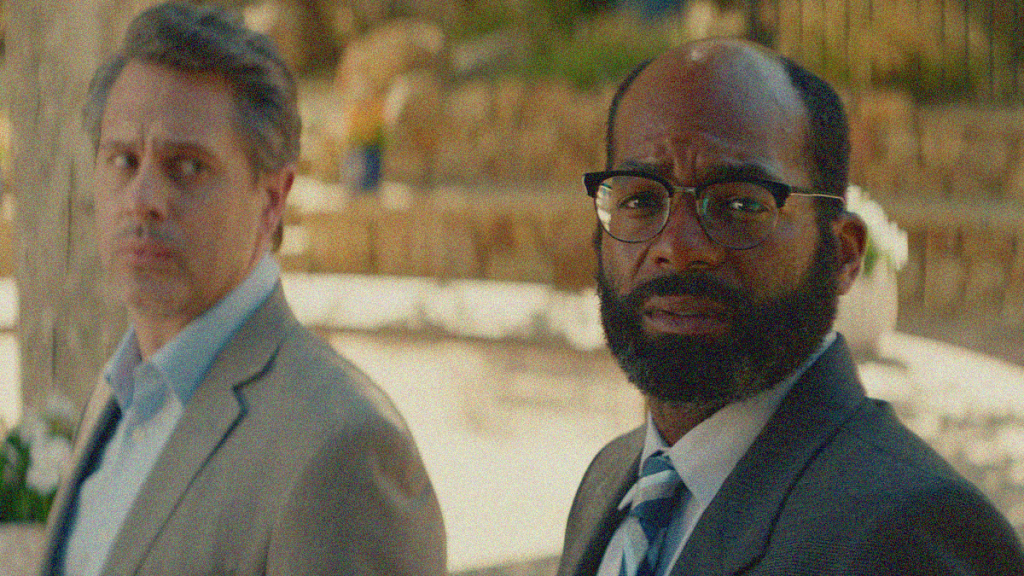
Thomas Sadoski and Brandon Victor Dixon in 88; courtesy of Samuel Goldwyn Films.




 jaredmobarak.com
Leave a comment