
Rating: R | Runtime: 129 minutes
Release Date: June 8th, 2022 (South Korea) / December 26th, 2022 (USA)
Studio: CJ Entertainment / Neon
Director(s): Hirokazu Kore-eda
Writer(s): Hirokazu Kore-eda
He was cuter in the photos.
The debate is as follows: do “baby boxes” outside of churches provide a service to the unwanted children left behind or do they provide an excuse for parents to leave them? For the first third of Hirokazu Kore-eda’s Broker, those weighing this two-sided coin are adults.
There’s So-young (Ji-eun Lee) using the drop-off point for reasons yet to be revealed. Soo-jin (Bae Doona), a jaded detective on the trail of traffickers who use those boxes to procure their “goods.” And the duo of Sang-hyeon (Song Kang-ho) and Dong-soo (Gang Dong-won), traffickers with hearts of gold who take So-young’s son in order to place him with a suitable family. To half of them it’s a means towards happiness for the child. To the other it’s a scourge on society. In reality, however, it can never be so black and white since good intentions and unfortunate results will always be intertwined.
It’s around the middle third that a shift occurs. That’s when we discover more backstory such as Dong-soo having been one of those children. We learn more about So-young’s motives, that Sang-hyeon is a father, and that Soo-jin (with help from her partner, Lee Joo-young’s Detective Lee) isn’t as callous as she may let on. Add a stowaway in the form of eight-year-old orphan Hae-jin (Seung-soo Im) and you suddenly realize Kore-eda has filled his script with every possible person who might have insight or opinion on the subject.
Those who have survived it, those currently living it, and those about to fall prey to its potential as well as those who haven’t needed to go down that route, those currently forced to see it through, and those positioned to evolve their stance upon witnessing just how much more complicated the subject is than what headlines and hardline morality pretend.
Broker exists in that gray area. Right off the bat we see that Sang-hyeon and Dong-soo aren’t bad men. Yes, they sell babies for profit, but they do so with the child’s interests at heart—perhaps more so than the church they’re stealing from. It’s similar with Soo-jin and her quest to enforce the law only to gradually see that the law’s inability to use nuance is perhaps more damaging than breaking it.
We hear this truth from countless players including those who run orphanages and those who’ve come to understand it is sometimes better not to be adopted when the alternative can prove worse. Add the fact that the system (especially so-called “pro-life” systems in the US) often blames the child it forced to be born and subsequently throws it away itself into poverty, crime, and death and you have to start questioning whether anyone actually values lives above money.
That’s why it’s such a joy living inside Sang-hyeon’s busted-up van for the duration. We see experience true love and compassion with this rag-tag bunch of abandoned souls who’ve found a genuine desire to help each other reach their potential outside a cutthroat system willing to throw anyone to the wolves as a means towards self-preservation. Not that this organic sense of family is enough. Crimes have been committed that cannot simply be ignored.
But even those can be forgiven if not justified by listening to their stories and contextualizing their actions (past, present, and future). And if they can endear themselves to us, who’s to say they can’t endear themselves to Soo-jin too? That’s where the human interest appeal lies. Because societal and cultural change cannot happen purely in a vacuum. Those upholding the rules must be able to open their eyes to the fact they have the power to interpret them in relation to the cost of their inflexibility.
Kore-eda delivers another winner as a result. With fantastic performances and an intelligence to the storytelling that refuses to sacrifice authenticity for happy endings, he’s showing us society’s flaws while highlighting those best suited to fix them: the ones harmed most by their injustice. Pair it with the director’s Shoplifters (or most of Ken Loach’s oeuvre) and you have the evidence necessary to prove why term-limits in government and equity in representation matter.
If you refuse to listen to those under society’s thumb because those in power have tricked you into believing they found themselves in that spot through their own inaction rather than the powerful’s action, you’re more likely to also end up under it than ever be at their side. Because the privileged don’t care about you. To them equality is oppression.
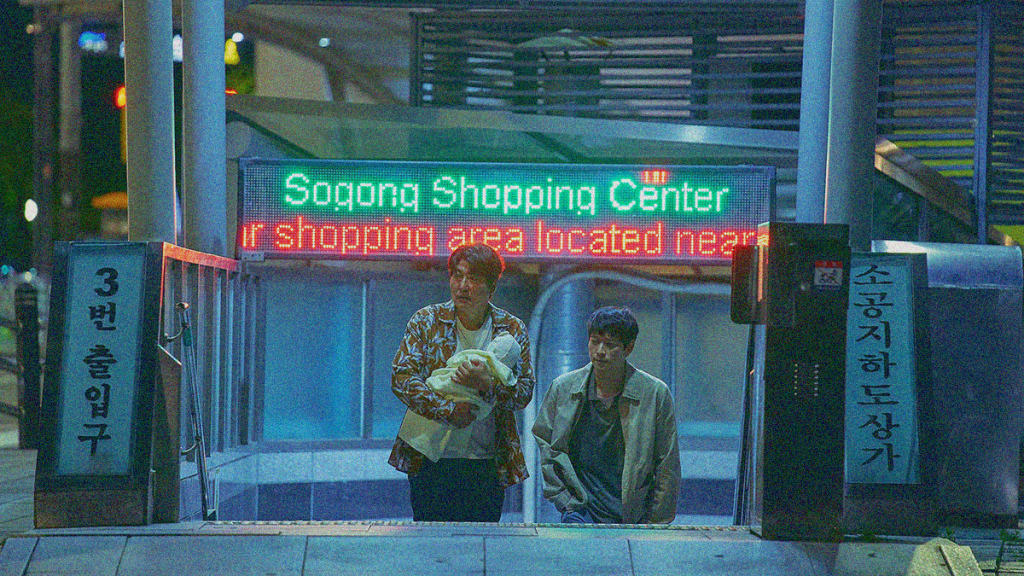
Song Kang-ho and Gang Dong-won in BROKER; courtesy of Neon.


 jaredmobarak.com
Leave a comment