
Rating: NR | Runtime: 104 minutes
Release Date: February 3rd, 2023 (USA)
Studio: Utopia
Director(s): Clay Tatum
Writer(s): Clay Tatum & Whitmer Thomas
Is this what you wanted?
Begun as an idea to simply shoot a small-scale film during the pandemic in a way where it would mostly just be him and his friend/co-writer Whitmer Thomas, Clay Tatum’s The Civil Dead may never have become anything more without an old friend (Mike Marasco) calling out-of-the-blue to pitch financing his next project.
A budget of thirty thousand dollars was all he’d need to get this concept off the ground—especially after the additional thought of making Whit into a ghost only Clay can see. There would be a need for more actors to help flesh out a narrative, but the conceit ensured the majority could work as a two-hander between friends trying to figure out an impossible situation.
Because this isn’t a normal scenario. Even if you believe in ghosts and the notion of “hauntings,” we’re talking about a supernatural trope that deals in horror, jump scares, and the macabre. To therefore come at it from a place of civility and kinship proves an intriguing wrinkle in and of itself. Whit doesn’t want to be a burden. He’s just ecstatic to have found someone who can see him let alone have that someone be a person he knows.
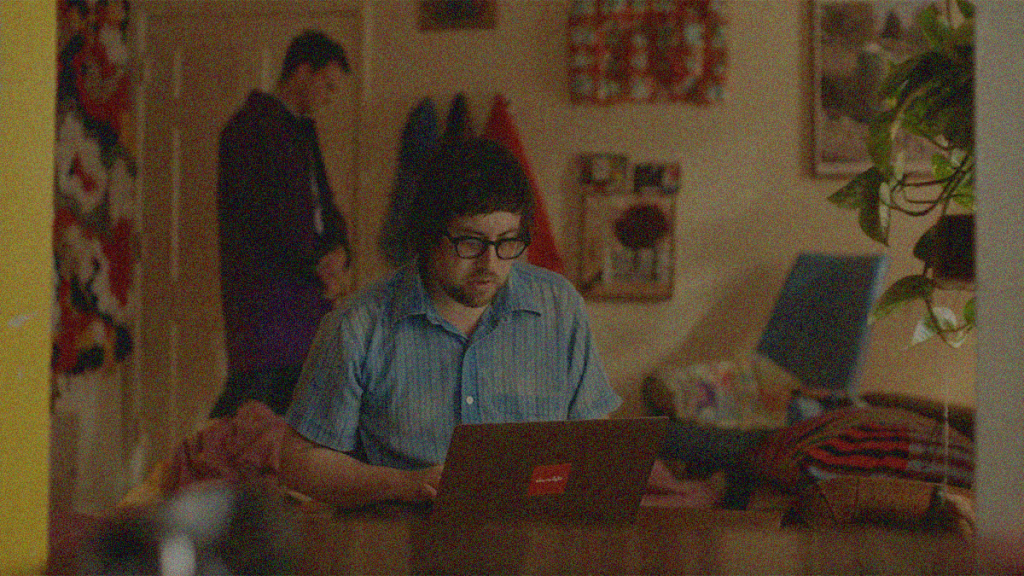
Whit has been roaming the streets of Los Angeles as an invisible specter with nothing to do and nowhere to go. Since he can’t walk through walls or open doors, he can’t really go anywhere. So, when Clay crosses his path and acts like nothing is amiss, why wouldn’t Whit take the opportunity to go somewhere new?
And therein lies the real reversal: Clay isn’t afraid of Whit. Not in the usual sense. It’s actually Whit who’s afraid of Clay, knowing that this dynamic probably can’t/won’t last forever. What would Clay’s wife say if he told her he invited a ghost she can’t see to live with them? What happens when Clay decides he’s had enough and Whit loses the only human being who knows he exists?
The uncertainty and frustration leads Whit to lose his cool and cause unexplainable events that do him no help on the “friendly ghost” front. The plot’s comedy soon exposes a tense underbelly of anticipation as far as Whit finally going too far or Clay pushing back to a point of no return.
With a memorable supporting turn from Robert Longstreet and a number of unsuspecting victims, Tatum and Thomas take us on an entertaining ride through the selfish potential born out of having an invisible ally. It can feel a bit long at times, but I don’t think the filmmakers ever overextend the joke. It helps that they acknowledge the dark places inherent to the conceit and the fact that their main character Clay is hardly a trustworthy guy who’s able to look out for anybody but himself (wife included).
So, like so many horror-adjacent films in recent years, The Civil Dead’s monster isn’t the creature hiding in the shadows. It’s the living, breathing, regular Joe who’s calculating the point where that which can be gained no longer offsets that which can be lost.
Whitmer Thomas and Clay Tatum in THE CIVIL DEAD; courtesy of Utopia.



 jaredmobarak.com
Leave a comment