
Rating: PG-13 | Runtime: 95 minutes
Release Date: May 13th, 2022 (Ireland) / March 3rd, 2023 (USA)
Studio: Break Out Pictures / Super LTD
Director(s): Colm Bairéad
Writer(s): Colm Bairéad / Claire Keegan (short story Foster)
If there are secrets in a house, there is shame in that house.
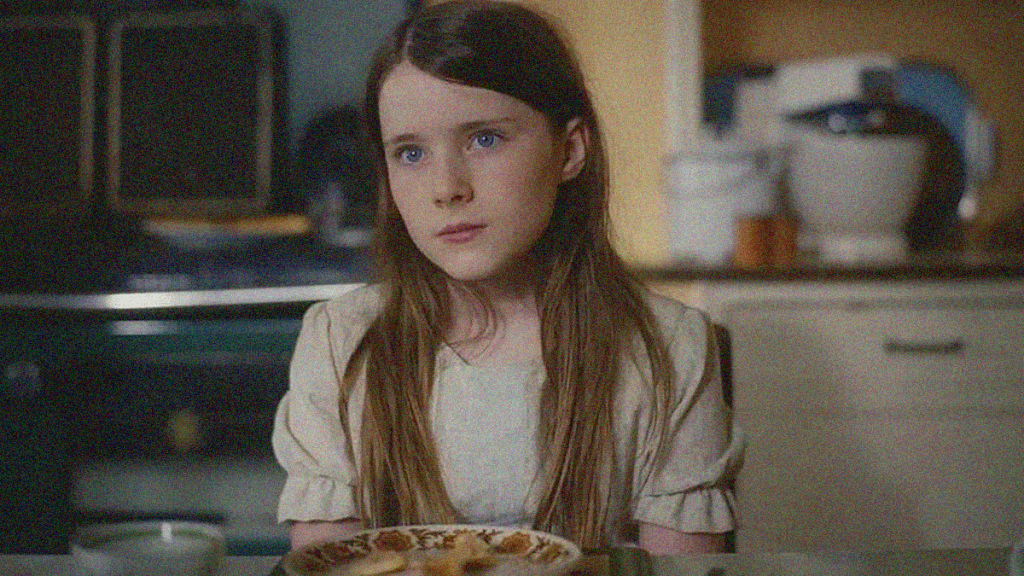
There’s reason for young Cáit (Catherine Clinch) to be withdrawn. She’s the fourth girl in a family of five children with another baby on the way. If Da (Michael Patric) isn’t drinking at the pub or having an affair, he’s home gambling their money away while Mam (Kate Nic Chonaonaigh) struggles to keep the house in some semblance of order.
Add her sisters treating her like a pariah and classmates calling her “weird” and it’s no wonder she seeks escape and isolation in the weeds or that her anxiety and neglect leads to nightly bed-wettings. But it also means more time spent worrying about Cáit than Mam can afford. So, with the baby coming soon, a summer reprieve becomes a godsend as cousin Eibhlín (Carrie Crowley) and her husband Seán (Andrew Bennett) offer to take her in.
Adapted from Claire Keegan’s novella Foster, Colm Bairéad’s The Quiet Girl ultimately proves to be as much a coming-of-age story for Cáit due to her time away from home being the first she’s ever felt truly loved as it is a balm for Eibhlín and Seán. They’re almost as quiet as the girl, stuck to their chores and rituals in ways that keep them at a distance.
She therefore embraces Caít’s presence as welcome company—less about having someone to dote on or put to work than to no longer feel alone. It’s inevitably a strange scenario for Caít at first since she’s never experienced the sort of unconditional kindness shown. She’s more used to the fits of rage Seán delivers, although not the genuine contrition found shortly afterwards.
He has his reasons. The same as Eibhlín has hers in the opposite direction. Seán is trying his hardest not to find himself repeating the past with Caít while Eibhlín looks to relive it for as long as she can. What that past is will soon be revealed by way of a gossipy neighbor, opening everyone’s eyes on-screen (as well as our own) to the reality that this summer can’t be lost in nostalgia or mistrust.
It must be enjoyed as a dream and remembered for a joy unencumbered by guilt or regret. The only caveat is, of course, that it has an expiration. At a certain point Caít must return home while Eibhlín and Seán reclaim the silence of theirs. The hope is that they’ll all be able to bear it or even find the ability to change their fate for the better thanks to what they found in each other.
It’s a subdued drama that allows us to sit with the characters as they sit with each other, owning Seán’s words insofar as it’s okay to not speak when speaking only proves the speaker should have kept his/her mouth shut. Because it’s in the silence that they find authentic empathy with a cookie or hairbrush. One mustn’t fake it or overcompensate when you can simply exist with a smile as the day’s work gets done with fun rather than resentment.
Don’t expect that to suddenly translate into some rousing bit of excitement, though. This story doesn’t need such gimmicks when a perfectly executed example of narrative mirroring is enough to express love via a hug—both the one that’s not given and the one that will warm your heart and put a tear in your eye.
The Quiet Girl had an Oscars-qualifying run on December 16th, 2022.

Nominee:
International Feature
Catherine Clinch in THE QUIET GIRL; courtesy of Super LTD.



 jaredmobarak.com
Leave a comment