
Rating: PG | Runtime: 109 minutes
Release Date: October 21st, 2022 (USA)
Studio: Netflix
Director(s): Margaret Brown
Writer(s): Margaret Brown & Kern Jackson
There’s a reason Timothy Meaher had the Clothilde set on fire and sunk after the slaves it was holding disembarked. Silence. Beyond those who were involved with the mission—said to have been launched on a bet to prove he could still bring Africans to the US circa 1860 despite it being illegal under federal law and punishable by death since 1808—nobody could hold him accountable if the evidence disappeared. He didn’t count on the Confederacy losing the Civil War, though. He didn’t count on the slaves from that ship reclaiming their freedom five years later to tell their story and inspire those who were born in chains to know a future existed for them despite what they were told. You can’t erase the truth once it’s unleashed.
Like so many examples through history, however, words aren’t enough when those who tried erasing that truth maintain power. That’s why it became important for the descendants of the Clothilde to find it. Doing so would not only provide answers for their history that rumors had thus far sustained, but it would also ensure those responsible were held to account a century after pretending like it never happened. But as Margaret Brown’s documentary Descendant shows, the struggle doesn’t end there. Not with one hundred years to unpack and discover how little has changed. Cancer ravages the community of Africatown courtesy of volatile industrial factories surrounding it that were approved by, built by, and still operating on land owned by the Meahers and their peers.
This is therefore more than just an excavation of a slave ship. It’s an excavation of the soul. Does knowing help you move on? Does it help you dig in deeper for a fight? We hear from the last survivor of the Clothilde (Cudjoe Lewis) thanks to Zora Neale Hurston’s published account of his words Barracoon as well as the descendants living in his honor. We see the differing opinions of parents and children as far as what this discovery means and where they go next when the risk of celebrating might allow the same families who profited off their ancestors’ bodies then to profit off the tourist potential of their story today. And, thanks to Brown, we see countless white people stick their feet in their mouths. It seems she correctly left little of that on the cutting room floor.
The result is a powerful account of a living history. That which happened doesn’t just end because time passes. The consequences and pain reverberate through generations. The hope is that we have finally arrived at a moment where the country won’t turn a blind eye as the people of Africatown are exploited again, but that the next steps are watched with scrutiny and ultimately left in the descendants’ hands to decide how to push forward. It may seem simple, but watching the divers who helped recover the ship lead a class to teach young Black boys and girls how to swim is an invaluable development in and of itself. Because it’s not about closure. As one woman explains, it’s more a circle back to the beginning to reclaim what was taken and rewrite their future.

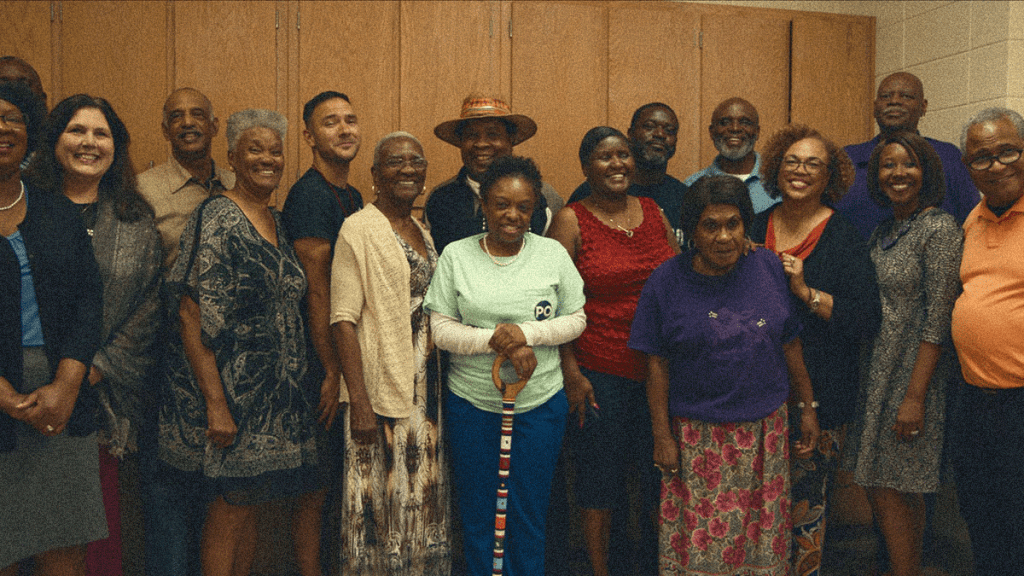
Clotilda descendants and community activists in Descendant. Cr. Participant/Courtesy of Netflix © 2022




 jaredmobarak.com
Leave a comment