
Rating: NC-17 | Runtime: 167 minutes
Release Date: September 16th, 2022 (USA)
Studio: Netflix
Director(s): Andrew Dominik
Writer(s): Andrew Dominik / Joyce Carol Oates (novel)
Isn’t all love based on delusion?
Smarter people than me have written about the moral issues behind Joyce Carol Oates’ novel and Andrew Dominik’s film Blonde. Is three-hours of exploitation justified if the exploitation is the point? Does this story being told under the identity of Marilyn Monroe add something that a story about a fictional approximation couldn’t possess?
How does saying it turns the mirror on public perception and Hollywood’s objectification of the actress square with also saying it’s about an alternate personality created by Norma Jeane Mortenson that saved her life before destroying it? Does that mean she also objectified herself? That she’s to blame for everything? The more Oates and Dominik talk, the more I believe they’re falsely intellectualizing a fan-fic they’re too pretentious to just call fan-fic.
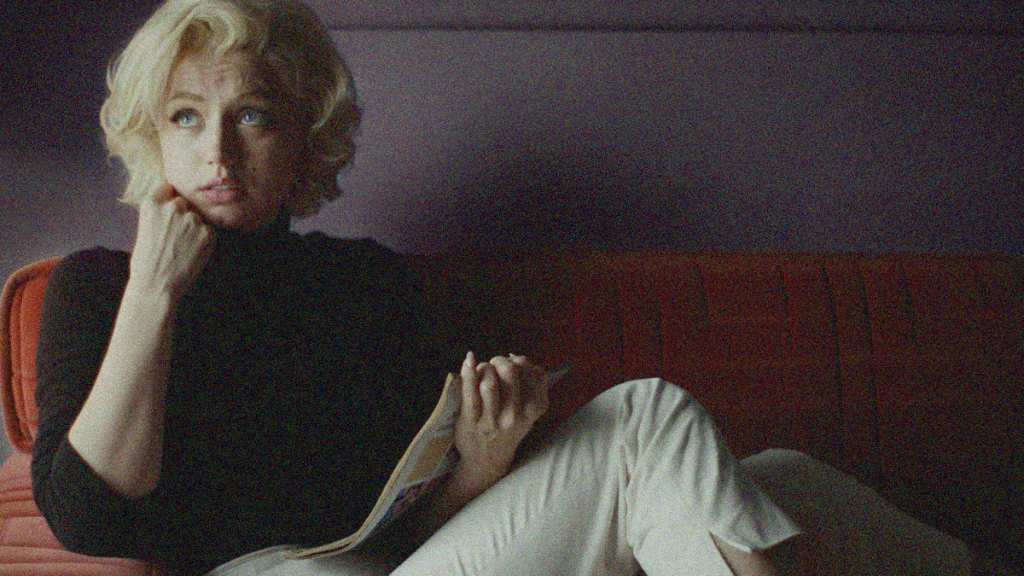
Here’s the thing, though: I don’t really care either way. I can’t because the movie itself is as empty a vessel as it tries to paint Marilyn Monroe to be. So, there’s no reason to dig deeper into the subtext if the text isn’t worth the time to wonder. It’s a shame too because Ana de Armas is great in lead the role. She pours her heart and soul into the struggle and pain that always seems to suppress whatever brief moments of elation Norma is able to find.
But this is a manifestation of assumptions and preconceptions. It’s a caricature meant to expose itself as a façade without ever truly introducing us to the real person. Lily Fisher plays Norma Jeane and she dies the moment she’s dumped into an orphanage. de Armas plays Marilyn Monroe—or, as she describes it, “just some blonde.”
This isn’t therefore some profound exercise. It doesn’t split apart an icon into the two personalities wrestling within. It can’t because it never tries to grapple with honesty or authenticity when salaciousness and abuse proves more “exciting.” Dominik isn’t interested in either of those things anyway since the film proves to be little more than a series of photographs brought to life.
If Blonde is an exercise, it’s an exercise in aesthetic. It craves the façade. It needs it. The moment truth enters the equation is the moment everything falls apart, so he avoids it like the plague. Whenever the chance to really mine Norma’s emotions arises after the numerous traumas she endures, Dominik simply cuts to the next chapter of make-believe, sex, and/or drugs.
I did enjoy the Arthur Miller (Adrien Brody) portion, though. It flirts with honesty even if it too keeps us at arm’s length for the duration. Because arm’s length is better than being miles away like so many of the other vignettes. Characters come and go so fast that you could really cut an hour out and lose nothing but the beautiful pictures created from the noise. That and the many opportunities to put a camera in Norma’s womb to speak with a trio of fetuses.
I’m half surprised conservatives haven’t ignored the nudity long enough to take this film under their wing as Pro-Life propaganda. Norma even calls her own mother “brave” for having her when an abortion would have been so much easier. It’s as though the one lesson from this entire tragedy is that Norma may have survived if she had been able to become a mom.


Nominee:
Best Actress
Ana de Armas as Marilyn Monroe in BLONDE. Cr. Netflix © 2022.


 jaredmobarak.com
Leave a comment