
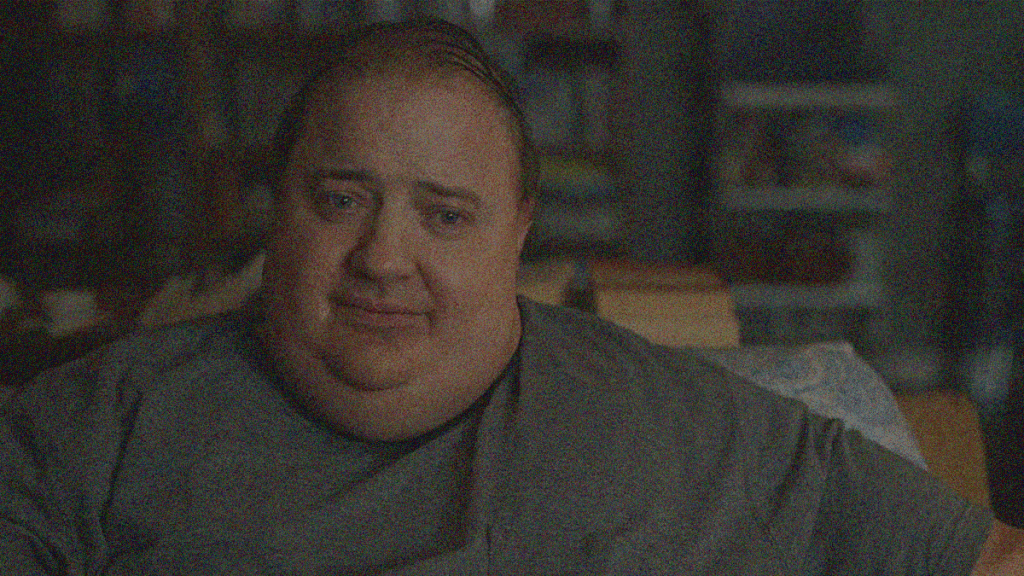
Rating: R | Runtime: 117 minutes
Release Date: December 9th, 2022 (USA)
Studio: A24
Director(s): Darren Aronofsky
Writer(s): Samuel D. Hunter / Samuel D. Hunter (play)
Do you ever get the feeling that people are incapable of not caring?
Watching Darren Aronofsky’s cinematic adaptation of Samuel D. Hunter’s play The Whale doesn’t make me wonder how it works on-stage as much as how it might work under the guidance of a more sympathetic director. That’s not to say Aronofsky is unsympathetic. I think he and Brendan Fraser bring the character of Charlie to life in a way that objectively humanizes him and allows his pain—created from an unyielding anguish and depression—to be understood.
Unfortunately, however, you cannot deny that Aronofsky doesn’t also lean into the external, horror-infused perspective that people like Charlie are often dismissed as grotesque, pitiable monsters. It’s therefore tough to reconcile our desire to empathize with the tempest of emotions surrounding him against an adaptation that seems hellbent on preventing us from doing so.
It’s a slippery slope. You do need to depict people’s heinous persecution of him since it’s a part of his story. A lot of what Charlie has become stems from the stigma that society places upon obesity (and homosexuality). The trick is thus not using that depiction in a way that, intentionally or not, normalizes that reaction. We spend almost ninety minutes with Charlie as he bares his soul while the facts surrounding his struggles (fatherhood, sexuality, religion, mental illness, etc.) are revealed.
Why, after all that, do you then create a scene wherein he’s “caught” in public in such a way that the person who sees him runs away? What does that add? It’s one thing if the film was about said reaction en route to judging society’s shortcomings. But it’s not. It doesn’t. So, choosing to portray it anyway feeds into calls of exploitation. You don’t need that shame to then catalyze Charlie’s subsequent decision to voluntarily be seen. Thinking you do is lazy.
What a shame too considering the performances Aronofsky receives from Fraser (the fat suit, while problematic, was always going to prove necessary for financing since this film doesn’t get made with an unknown entity who’s naturally that size) and Hong Chau as his friend/nurse Liz. They imbue a bottomless wealth of compassion and history to these characters—so much so that the love they share easily outweighs the cruelty of others sneaking in.
Their tenderness provides the leeway to let Sadie Sink’s Ellie (Charlie’s estranged daughter) be so vicious. She has every reason to be that way after all. His obesity is merely an easy target with which to package her justified rage. It does beg us to ask the million dollar question, though: Why make Charlie obese at all? Because being able to narratively use it as a means of manifesting his self-loathing and guilt isn’t good enough. That renders it a stunt and ultimately feeds into the stigma rather than combat it.
You can argue that it’s just one example of many instances of psychological trauma on-screen, but it’s the only one that takes physical shape. Ellie’s issues don’t utilize a fat suit. Thomas’ (Ty Simpkins) don’t either. At a certain point, Charlie’s disability stops being a character trait to become the entire character.
And yet the film continually refuses to acknowledge it because it would rather just use it as a trigger for Charlie to want to get his affairs in order. That way Hunter can ratchet up the drama via more secrets couched in a not-so-deep commentary on Red State politics without ever confronting the sickness itself. Because without Fraser and Chau’s performances, that’s all this really is: a shallow plea for kindness in a world so cynical that people have grown less accepting than they already were in hopes that God gives them a reserved seat at the apocalypse.

Winner:
Lead Actor, Makeup and Hairstyling
Nominee:
Supporting Actress
Brendan Fraser in THE WHALE; Credit: Courtesy of A24.

 jaredmobarak.com
Leave a comment