
Rating: R | Runtime: 110 minutes
Release Date: November 19th, 2008 (France) / February 13th, 2009 (USA)
Studio: Wild Bunch Distribution / Magnolia Pictures
Director(s): James Gray
Writer(s): James Gray & Ric Menello
You deserve to be loved.
Leave it to Joaquin Phoenix to quit the business after giving his finest performance to date. The role of Leonard Kraditor in James Gray’s Two Lovers is an amazing turn from someone who’s been often relegated to the cool, confident leading man. Yes, I know his portrayal of Johnny Cash had its moments of vulnerability, but the closest character I can compare this to would be Lucius Hunt from The Village: a shy, kind-hearted soul in love who’s unable to find his voice.
Never in a million years would I have thought this from looking at the horribly Photoshopped Cannes poster including a suave Phoenix between two glam shots of Vinessa Shaw and Gwyneth Paltrow. In what could be the worst marketing piece of the year, it’s the main reason I had zero interest in checking this out. (The final one-sheet does a much better job). Only after hearing the buzz and seeing it on end of year lists did I decide to watch. All that praise is warranted for both the lead and the movie itself—a very strong drama dealing with the pains of life and the hope for happiness despite our propensity to look the other way.
Phoenix’s Leonard is a thirty-something New Yorker who has recently broken up with his fiancé and moved back home to his parents’ apartment. Our introduction to his character is with an ‘accidental’ fall into the Bay and eventual resurfacing where a group of good Samaritans help him remove the water from his lungs. Only when he arrives home and his mother (a nice turn from Isabella Rossellini) whispers to her husband that she thinks “he tried it again” do we comprehend the stifling depression he faces.
His demeanor is awkward and unsure as he’s forced to meet a girl his family maneuvered over for dinner right after that midday swim. It’s very refreshing to watch him look at the floor, mumble his way through conversation, and fumble through the dinner full of innocence. He’s like a young child, always watched by his parents as they prod him to open up and find the happiness he lost when his engagement ended. Leonard is on medication and slightly off-kilter, lending him an appearance of inexperienced youth that Shaw’s Sandra finds cute and appealing … like a little dog in need of care.
Leonard soon takes on another persona completely, however. One trying to be cooler than he has been in sometime by reaching back to happier days of fun and excitement. It’s all precipitated by his meeting a beautiful neighbor (Paltrow’s Michelle) with whom he becomes fast friends. Self-conscious and highly aware that she’s a woman to be coveted, we soon see his walk inherit a hitch in its step as his words become spiced with vulgarities and his attitude morphed into one devoid of inhibition.
When he joins Michelle and her friends clubbing, you can’t help laughing at his confidence telling stories, rapping, and even breakdancing to impress them. So, we become familiar with the two sides of his bi-polar nature: two worlds separated by the woman each loves. The issue soon becomes how he’ll be able to cope with this double life after having had no one but himself for so long. One has the security of a prosperous father about to merge companies with his own dad who’s completely in love with a broken man on the mend and the other is a wildcard with a substance abuse past and a boyfriend married with a son.
The driving question is whether the duplicitous lifestyle will be too much for Leonard to bear and eventually hurt him so heavily that he spirals back to the suicidal tendencies he just left behind. He’s a complicated fellow who’s not easily understood. One could say he creates his own troubles by attaching himself so quickly to anyone that shows a modicum of affection, but you must understand the psychological issues he’s struggling with.
Only his mother’s eyes are truly open to her son’s plight. She watches his strange and eccentric activities without judgement because she must believe that he will either finally find his way or come back to her if he gets hurt again. The performance is fully realized as a man with issues an audience can relate to and a love that cannot seem to find stability. One could say Sandra is the safe answer to his troubles, but that does her a disservice. It’s just like how saying Michelle is the fantasy belittles her own problems and naivety in love.
All three characters are in dire need of answers. The triangle Phoenix constructs is set up to inevitably hurt one, if not all, of the trio when the end arrives. They may have stereotypical issues, but none comes across as clichéd due to these wonderful performances. Paltrow branches out to show a vulnerability that you sometimes forget she can pull off while Shaw exudes her own desire to be needed by opening up to be loved while risking a devastating letdown we can’t help but anticipate. James Gray has given these actresses the room and material to sink their teeth in and complement his current acting muse.
So many small moments resonate and stay with you. The direction is strong and non-invasive to let the actors speak for themselves and the ending is so real in its messiness to set a chain of events in motion that make you question whether motives are pure or all that’s left. Watching Phoenix enter the room and walk across with music playing while every other sound is drowning out proves a great sequence culminating in a brief shot of him peering straight into the camera. It’s a questioning glare that brings us in as part of his decision to either leave the viewer with a sense of joy or anger depending on their interpretation of what transpired.
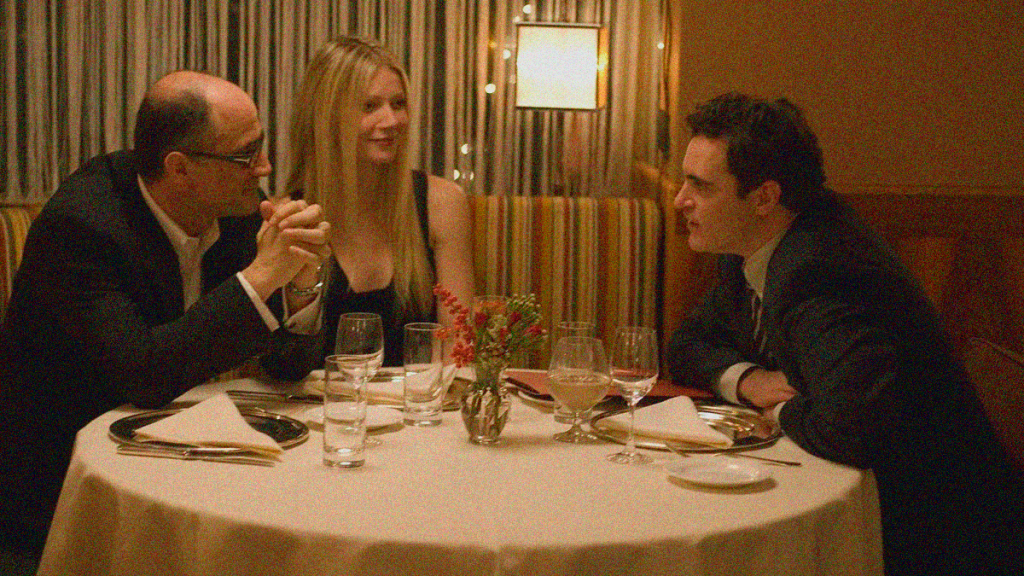
Elias Koteas, Gwyneth Paltrow and Joaquin Phoenix in TWO LOVERS, a Magnolia Pictures release. Photo courtesy of Magnolia Pictures.



 jaredmobarak.com
Leave a comment