
Rating: R | Runtime: 114 minutes
Release Date: September 5th, 2008 (UK) / October 8th, 2008 (USA)
Studio: Warner Bros.
Director(s): Guy Ritchie
Writer(s): Guy Ritchie
Was it a slow dance?
Is Guy Ritchie back? Has the impending divorce brought back that violent edge we fans have been missing? I guess it’s somewhat idiotic of myself, and others, to dismiss Ritchie as though he’s left the playing field. Sure, Swept Away couldn’t have been good as art let alone for his career, but besides that and what some consider a bloated mess in Revolver, Ritchie hasn’t imploded. The guy made two great cockney gangster flicks and with his newest film, RocknRolla, continues the tradition by pulling the train back on its tracks … if he ever really derailed at all.
I can’t stand people saying he needs to stop writing the same film over and over again. Do you like them? Then who cares? If it works, run with it. Ritchie is skilled enough to create nuance to his tales and, despite the good ones all pertaining to the seedy workings of the British underworld, they aren’t carbon copies of each other. RocknRolla shows a definite maturity in style with some brilliant visual sequences as the action/humor/violence fills the screen at every turn.
It’s always a pleasure to see the narrator gimmick succeed. The entire story is told by Archie, played with gritty toughness by Mark Strong (this guy is everywhere now). He treats us to backstories, flashbacks, and observations on the day-to-day dealings working under London boss Lenny Cole—a volatile Tom Wilkinson chewing massive amounts of scenery. Strong helps explain the interesting coincidental connections that seem to always occur in the crime world with everyone running into each other at some point.
I really believe this helped me overlook multiple instances of convenient storyline overlapping, something necessary to be invested in the film. Every criminal on-screen will at some point effect the life of the others whether intentional, unconsciously, or by sheer dumb luck. In this way, it all becomes a cohesive whole despite the jumping between character point of views and instances in time. Ritchie seems to have carefully orchestrated it all, uncovering every little detail at just the right moment to the audience regardless of whether it occurred before or after what precedes it. We’re shown it all in an order that bolsters the narrative, not necessarily the chronological timeline of those involved.
In that respect, certain characters are brought in and out of the story to enter our consciousness or be held back until we need them. It all begins with the junkie binge of rockstar Johnny Quid, a punk kid at once thought to just be a random slacker until his history is slowly peeled back. Toby Kebbell is a true RocknRolla, living the life of drugs, sex, violence, and anything else he can dip his foot in. My favorite character, by far, Quid meanders through the lives of everyone else as the one connection common to them all.
The pithiest junkie I’ve ever seen, the nuggets of wisdom he relates to his pal Pedro are equally astounding and unpredictable. A screw-up raised with every opportunity for wealth is purposely sending his life into the gutter, a fact that makes his psychobabble and cigarette metaphors even more entertaining. Because he spouts his intellect in a completely cynical, sarcastic manner. The kid is too smart for his own good and we all know his mouth will inevitably get him into trouble … setting up a great elevator monologue towards the end with his ex-agents played nicely by Jeremy Piven and Chris ‘Ludacris’ Bridges.
It will be tough to explain details of the plot without spoiling the entire thing. So, in a nutshell, it revolves around property. Wilkinson’s mob boss controls the planning committees and anyone else necessary for a large real estate deal to run smoothly. He has put himself into business with his Russian equivalent to build a new stadium in London. This interaction brings into play an expensive “lucky” painting that changes hands, two transactions of 7 million Euros intercepted by a ragtag group of lowlifes, and the question of freedom as a commodity being ruined by an unknown informant to the police. Ritchie keeps it all going at a breakneck pace, introducing a new wrinkle just when you think it’s slowing down. Culminating in a final confrontation with everyone bringing forth the truth of who they truly are, I don’t see how you cannot be entertained.
The cast is stellar throughout. Whether a known actor or unknown, each adds their own flair to the proceedings and keeps the interest level high. No one really leads. It;s a very even-handed ensemble with people coming in and out, doing their thing and stepping back to let everyone else do theirs. Thandie Newton is beautiful and intriguing as a corrupt accountant living a life of convenience, but never happy. Nonso Anozie is really funny as (“Think”) Tank finding all the nefarious deals on the street. Karel Roden shows why he reigns supreme with Russian villainy again. And Gerard Butler, Idris Elba, and Tom Hardy shine as the Wild Bunch—hired muscle having a great time doing everyone’s dirty work for them yet clueless to the big picture.
The best part of the film concerns them and the second money heist against a duo of indestructible Russians. Ritchie shoots it very artistically with a hand-held camera, jumping and shaking. The close-ups of faces cropped on the far right side, affixed to the actor as he runs is breathtaking. The humor never goes stale, the absurdity of the situation never trumps the fun factor, and the slowed to a crawl end to the chase due to fatigue is fantastic. It has it all: blood, violence, machine guns, physical humor, tempo changes, car crashes, and frenetic editing. This one sequence epitomizes the film’s ability to never leave you bored … unless the accents give you trouble. If that’s the case, rent it and use closed-captioning because reading will be worth it.
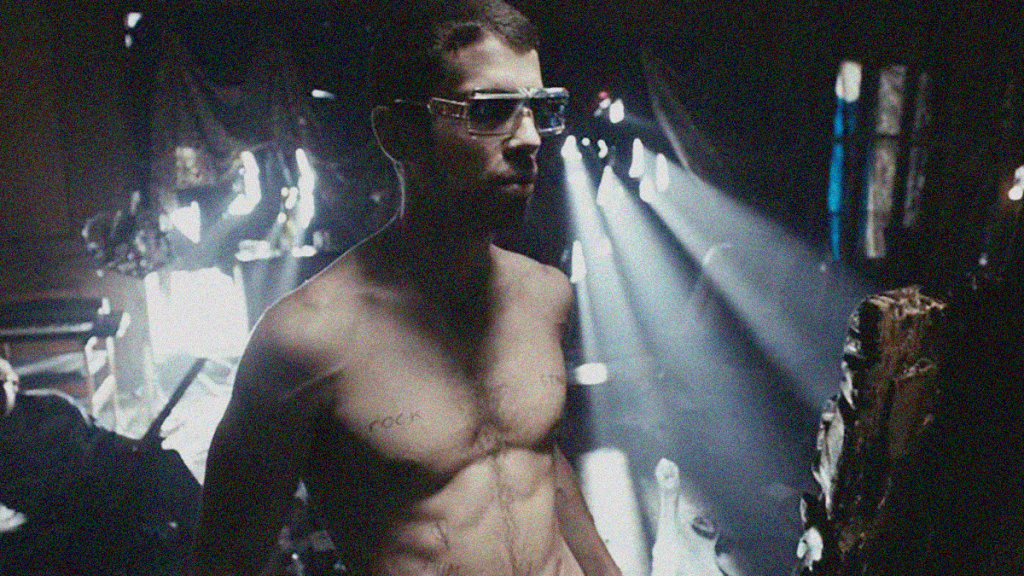
Toby Kebbell as Johnny Quid in Warner Bros. Pictures’ action film ROCKNROLLA. Courtesy of Warner Bros. Pictures.


 jaredmobarak.com
Leave a comment